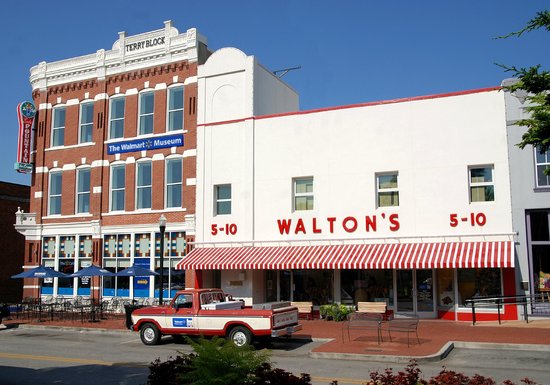
When I first tell people I hail from Bentonville, Arkansas their first reaction is often “Wow, I’ve never met someone from Arkansas before.” To them, Arkansas is a practically non-existent place that must be akin to a cluster of the small towns often depicted in the Hallmark movies my mother enjoys. When I first visited Bentonville, I thought the same, and in a way, my preconceptions were validated by the downtown area. The facades to all the buildings look like they are from another century and this is only highlighted by the Five and Dime with an old pickup permanently parked in front. On one side of the square is even a trolley selling lemonade, funnel cakes and popcorn with the classic red and white candy stripes and yellow light bulbs to draw one’s attention. Immediately, the square seems like a place that has been lost in time, but it was not until I read about heterotopias that I knew why.
In Foucault’s “Of Other Spaces,” he describes an opposite to what we know as a utopia, calling it a heterotopia. Rather than the perfected form of society, heterotopias are something else entirely. Foucault states: “There are also, probably in every culture, in every civilization, real places — places that do exist and that are formed in the very founding of society — which are something like counter-sites, a kind of effectively enacted utopia in which the real sites, all the other real sites that can be found within the culture, are simultaneously represented, contested and inverted” (Foucault 24). To me, this is something that perfectly defines Bentonville’s town square, but I shall use the principles laid out by Foucault to formally make my case.

To begin, Foucault speaks of two classes of heterotopia: crisis and deviation. Although people going to a town square are not specifically doing so in crisis or due to deviant behavior, the square itself is a deviation nonetheless. While learning about urban design, we saw how city layouts, if viewed from an aerial position, have changed from being unstructured to grid-like. This is a change that was fundamentally begun during the Renaissance times and is still implemented and improved upon in today’s world. Bentonville is no exception to this type of layout. It has a grid-like structure with street names that further exonerate the grid mentality by being either numbers or letters. For example, I could tell someone to meet me on the corner of First St and A St and diagonally from that would be Second St and B St, one of the most logical layouts one could imagine. However, this grid is then broken up by a deviation: the town square. This disrupts the logical flow of streets and the ease at which people can drive through town, making its purpose not efficiency but the opposite as it encourages socialization.
The second principle Foucault speaks of refers to the use of space as fluid and changing over time. A town square fits this perfectly, because as time has changed the use of such a space has as well. Popular uses for town squares in history were often violent, with many a military parade or execution or used for important gatherings of the townspeople. More recently, town squares have become lighter in fashion, holding more celebratory parades, concerts and festivals aiming to bring people together as a community. Personally, I have attended a Christmas Parade, seen Santa walking around and many prom pictures taken on Bentonville’s square. The change over time in town square use shows the importance of a centrally located open space to a city due to its accessibility and variability.
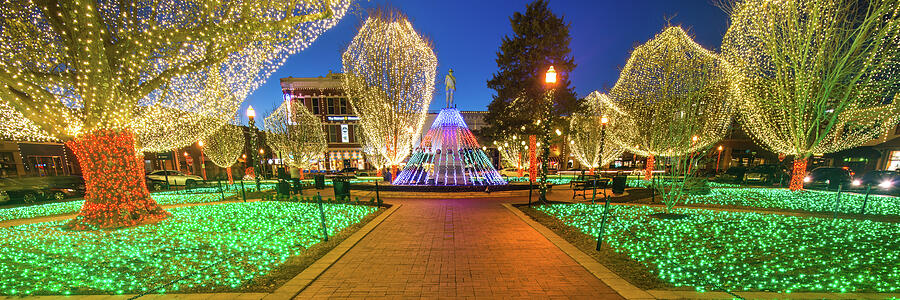
Thirdly, Foucault says “the heterotopia is capable of juxtaposing in a single real place several spaces, several sites that are in themselves incompatible,” (25). Drawing from my previous square observations, this is true of Bentonville’s square as well as many others. A child alive with the magic of Christmas while sitting on Santa’s lap and whispering their desired presents is incompatible with a couple dressed up in a smart tux and flowing dress, clinging to each other as they celebrate the end of their childhood by going to a high school prom. However, these sites can occur in one place and I would not be at all surprised to see them happen one day after another if prom did not occur in the spring. A town square does not confine what experiences can take place inside, but rather encourages the usage of several spaces inside of itself.
Next, Foucault requires a heterotopia be linked to “slices in time,” (26). As aforementioned, Bentonville’s square is definitely of another time. Not only are the building facades reminiscent of the style one would expect in the 1940’s, but Walton’s first Five and Dime still exists on the square. Upon entering, one can go through the Walmart museum and learn all about its founder, Sam Walton. At the end of the museum, one comes out into the ice cream shop with prices like those one would find when Walton was a young man. With a museum to transport people back in time and a ice cream shop that continues that experience with ice cream for less than a dollar, Bentonville’s town square truly feels like one stepped into a time machine.
The fifth principle states heterotopias must have a coexisting feeling of openness and closure that is either compulsory or illusionary. While I would argue that in history, the purpose of town squares was more compulsory due to its violent past, I believe this has since transitioned to illusionary. In cases like parades and concerts, there are restrictions in place that prevent the public from gaining access to certain places. During parades, people not a part of the parade are refused entrance to the street and during concerts the same is true of the performing area. This creates a necessary separation between people that gives the illusion of being a part of the town square functions, while also being restricted to a viewer who cannot participate. All at once the person is inside, but also on the outside looking in. Foucault says this best in the quote “Everyone can enter into these heterotopic sites, but in fact that is only an illusion: we think we enter where we are, by the very fact that we enter, excluded,” (26). Once you get past the barrier of buildings that attempts to close off the square, you are inside, but its an illusion.
Finally, heterotopias must have a function that either exposes space or create another space in compensation. Town squares as a whole fall under the compensation category by being as organized and bringing communities together perfectly within four sides. All while doing this, they counteract the chaos and individualism that exists throughout the rest of the town. The walls almost serve as a prison to show what socialization and neighborly attitudes should be exhibited by community members, despite often being forgotten once people leave. Bentonville’s town square is no different from this and by combining the attributes of deviation in structure, flexibility in function, juxtaposition of sites, being of another time, illusionary inclusion and compensation for reality it is by Foucault’s definition, a heterotopia.
Sources Foucault, Michel. Of Other Spaces. Www.foucault.info, 2000.
 Italy: Imagined & Realized