During my time in Europe this past summer, when I was working toward achieving my Global Competence Certificate, I visited Schwangau, Germany. Although this is the location of a popular tourist destination, the Neuschwanstein Castle, that which the famous Disney Castle is based on, what I found most beautiful was the nature of the surrounding area. Rather than trying to visit many places in Europe in one trip, I spent an entire week exploring a small section of Germany. I was able to become familiar with the tram routes, market times and found myself doing less touristy things and surrounded by locals. After reading de Button’s passage stating “He deplored the blindness and haste of modern tourists, especially those who prided themselves on covering Europe in week by train,” I decided to make my word-painting about visiting the town of a famous tourist site (218).
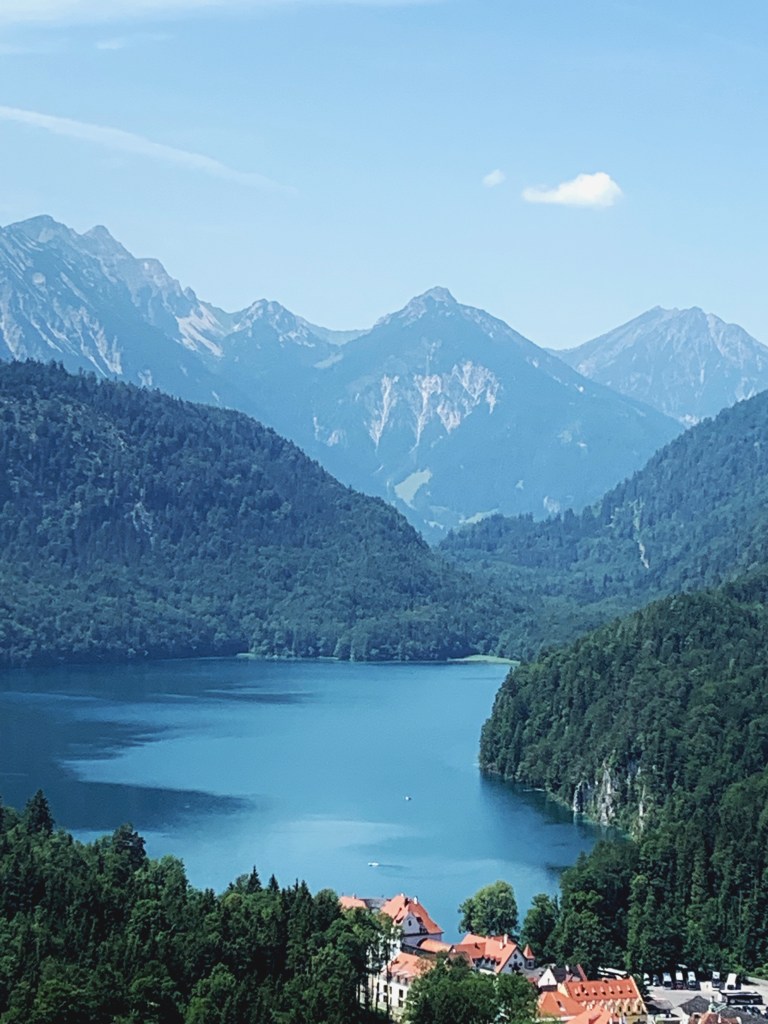
The beauty of this site immediately overcame me as I looked down from a path to the castle down on the small town of Schwangau. It was nestled in woodland mountains that seemed to embrace the lake they surrounded, making it seem even more brilliantly blue from a distance. Then the perfect background behind that scene was created by the Alps with their snowy peaks reaching even higher towards the clear sky, in contrast with the wooded mountains in front. It was easy to be overcome with a feeling of of awe and amazement when looking at this scene, a feeling that increased exponentially when I viewed it up close. Wading into the water allowed me to see it wasn’t the brilliant blue I had thought from a distance, but rather entirely translucent, reflecting the blue tones of the sky above. It seemed as though the lake did not want to be disturbed as it became muddled and hazy when one stepped on the rocks at the bottom, kicking up minuscule particles of sand. I did not stay in the water long, although it was a nice relief for my feet on a hot day. I enjoyed the view from the shore more, once the sand had settled and the lake was clear once again. The nature was meant to be appreciated as a wonder for the senses, showing what could exist without the interference of man. To step into the water created an interference, an illusion that one was part of the setting, when truly they were the imposters being given the gift of experiencing such a sight.
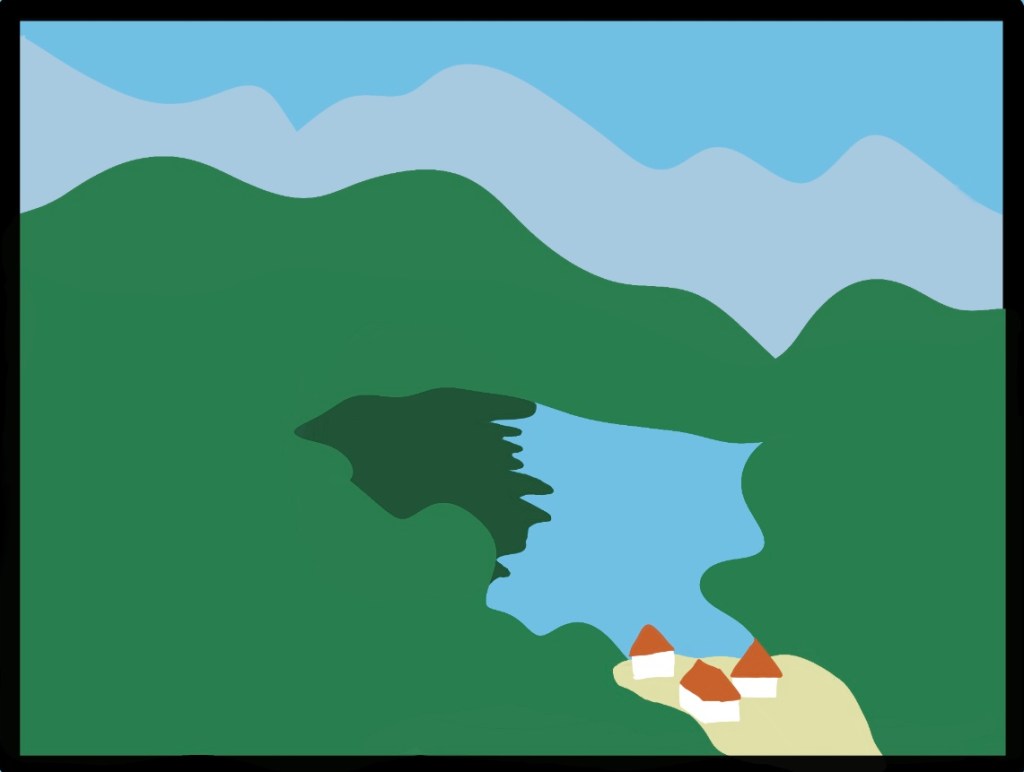
Despite the clear aesthetics of the scenery, the way I was psychologically affected by the site is what allows me to envision I am still standing on the shore. This was something Ruskin recognized as written by de Button: “many places strike us as beautiful not on the basis of aesthetic criteria–because the colours match or symmetry and proportion are present–but on the basis of psychological criteria, inasmuch as they embody a value or mood of importance to us,” (229). I relate to the way he goes on to describe the trees on the Alps as something that have “never heard human voice,” because this perfectly describes why I felt an imposter even looking at them from the viewpoint of the lake. It was clear to me I did not belong, but was gifted the knowledge that this was found in the world I live in. I drew the view from high above along the castle path, to show the untouched beauty I saw from a distance. This is one experience I know I will never forget and one I hope reoccurs in another setting.
Source:
Botton, Alain De. The Art of Travel. Hamish Hamilton, 2014.
 Italy: Imagined & Realized